Hiroaki OKADA (Ph.D., nematologist, a senior researcher of National Institute for
Agro-Environmental Sciences, )
|
|
Since I got a research position at the Japanese
Ministry of Agriculture, I have been attracted by nematode ecology, although
my concern was for water bugs' ecology when I was a student. The reason why I
have changed my research area from entomology to nematology
was that nematodes contain a lot of species and they show great variety of
life styles as well as insects do. Some nematode species are hated by farmers
because they sometimes cause severe crop damage, while other species, such as
entomopathogenic ones, are preferred because insect
pests can be controlled with them. Moreover, a nematode community as a whole
can be used as an environmental indicator for chemical contamination,
physical disturbance at crop fields, grasslands or forests. This broad range
of nematode "activities" charmed me to this science. Indeed my
interests are given to ecology of plant parasitic, insect parasitic and
free-living microbivorous nematodes. |
|
|
Research projects running |
|
|
|
|
|
Publications |
|
|
|
Refereed papers . |
|
|
|
|
13, Kadota, I., Oto, Y., Okada, H.,
Ishiguro and K.,Hagiwara, H.リンドウ「こぶ症」発症株の根部に見られる生育障害 (in Japanese) Annual Report of Plant Protection in |
|
|
|
10, Ahmad, W., Okada, H.,
Araki, M. (2003). Description of Nygolaimoides andrassyi sp.n. (Nematoda: Dorylaimida) from
northern |
|
|
|
9, Okada, H., Kadota, |
|
|
|
8, Okada, H., Tsukiboshi, T.
and Kadota , |
|
|
|
7, Okada, H., Ferris, H. 2001. Effect of temperature on
growth and nitrogen mineralization of fungi and fungal-feeding nematodes.
Plant and Soil 234, 253-262. 6, Okada, H. 1998 Rearing of larva of yellow striped
flea beetle, Phyllotreta striolata Fabricius, with
flesh leaves of crucifer vegetables (in Japanese). Annual Report of Plant
Protection in |
|
|
|
5, Okada, H. 1996 Effects of initial population density
of Meloidogyne arenaria
on yield and growth of soybean plant (in Japanese). Annual Report of Plant
Protection in |
|
|
|
4, Okada, H. 1995. Propagation of two fungivorous nematodes on four species of plant-pathogenic
fungi. Japanese Journal of Nematology 25, 56-58 |
|
|
|
3, Okada, H. and Nakasuji, F.
1993 Patterns of local distribution and coexistence of two giant water bugs, Diplonychus japonicus
and D. major Esaki (Hemiptera:
Belostomatidae) in |
|
|
|
2, Okada, H and Nakasuji, F.
1993 Comparative studies on the seasonal occurrence, nymphal
development and food menu in two giant water bugs, Researches on Population
Ecology 35, 15-22. |
|
|
|
1, Okada, H., Fujisaki, K and Nakasuji,
F (1992) Effects of interspecific competition on
development and reproduction in two giant water bugs, Diplonychus
japonicus Vuillefroy
and Diplonychus major Esaki (Hemiptera: Belostomatidae). Researches on Population Ecology 34,
349-358. |
Others
3, Okada, H. 2005 Nematode community indices to evaluate soil ecosystem
status and function (in Japanse). Plant Protection 59, 10, 423-426.
2, Okada, H. 2002 Mini
review: Role of nematodes in soil ecosystem -effects on dynamics of inorganic
nitrogen- (in Japanese), Root Research11, 3-6.
1, Okada, H. 1993
Ecology of two giant water bugs, Diplonychus
japonicus and Diplonychus
major and competition between them (in Japanese). Insectarium,
|
|
*My lovely worms* |
|
|
|
1, |
Opposite relationships of nematodes with fungi. Oyster
mushroom, Pleurotus ostreatus,
is known as "nematophagus fungus", since
the fungus hyphae excretes toxic chemical to
paralyze nematodes, and the hyphae resolve and
absorb nematodes' body. Indeed a fungal-feeding nematode, Aphelenchus
avenae, is being fed upon by the fungus (left, Click to zoom out!). However,
I recently found that the other nematode, Filenchus
misellus, can avoid the fungal attack and feed
on the hyphae (right)! For details please see my
paper coming soon in Soil Biology and Biochemistry. 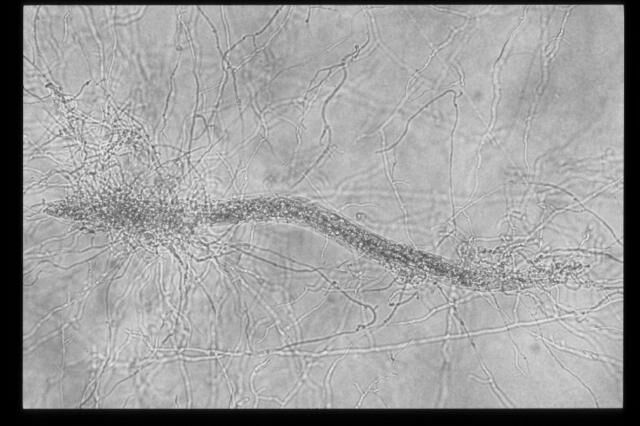 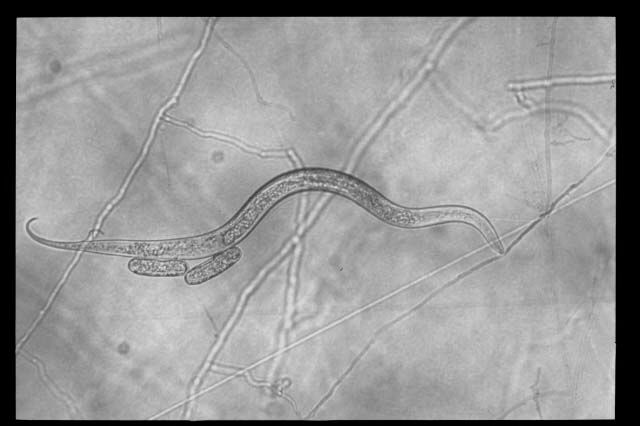 |
|
|
||
|
|
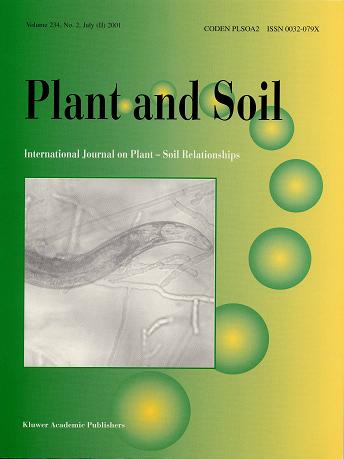
2, |
A nematode, Aphelenchoides
sp., is feeding on fungal hyphae. Fungal-feeding nematodes contribute to nitrogen mineralization under
certain conditions in soil ecosystems. My photo covered a front page of
Plant and Soil (Click!). |
|
|
 |
|
|
|
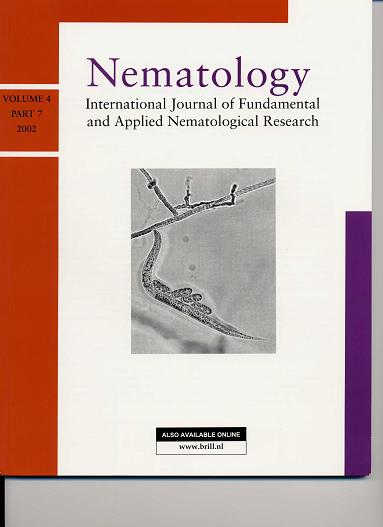
3, |
A nematode of 0.4 mm length, Filenchus
misellus, is feeding on fungal hyphae growing on water agar. This nematode is considered
as one of the primitive species in the order Tylenchida
which contains plant parasitic species such as root knot nematodes (Meloidogyne spp.) and
soybean cyst nematodes (Heterodera spp.) My photo of Filenchus,
on a front page of Nematology, indicates clearly for the first time the fungal-feeding habit of the nematode (Click!). |
|
|
|
|